Why Law Firm SEO ROI Must Reach Beyond Rankings

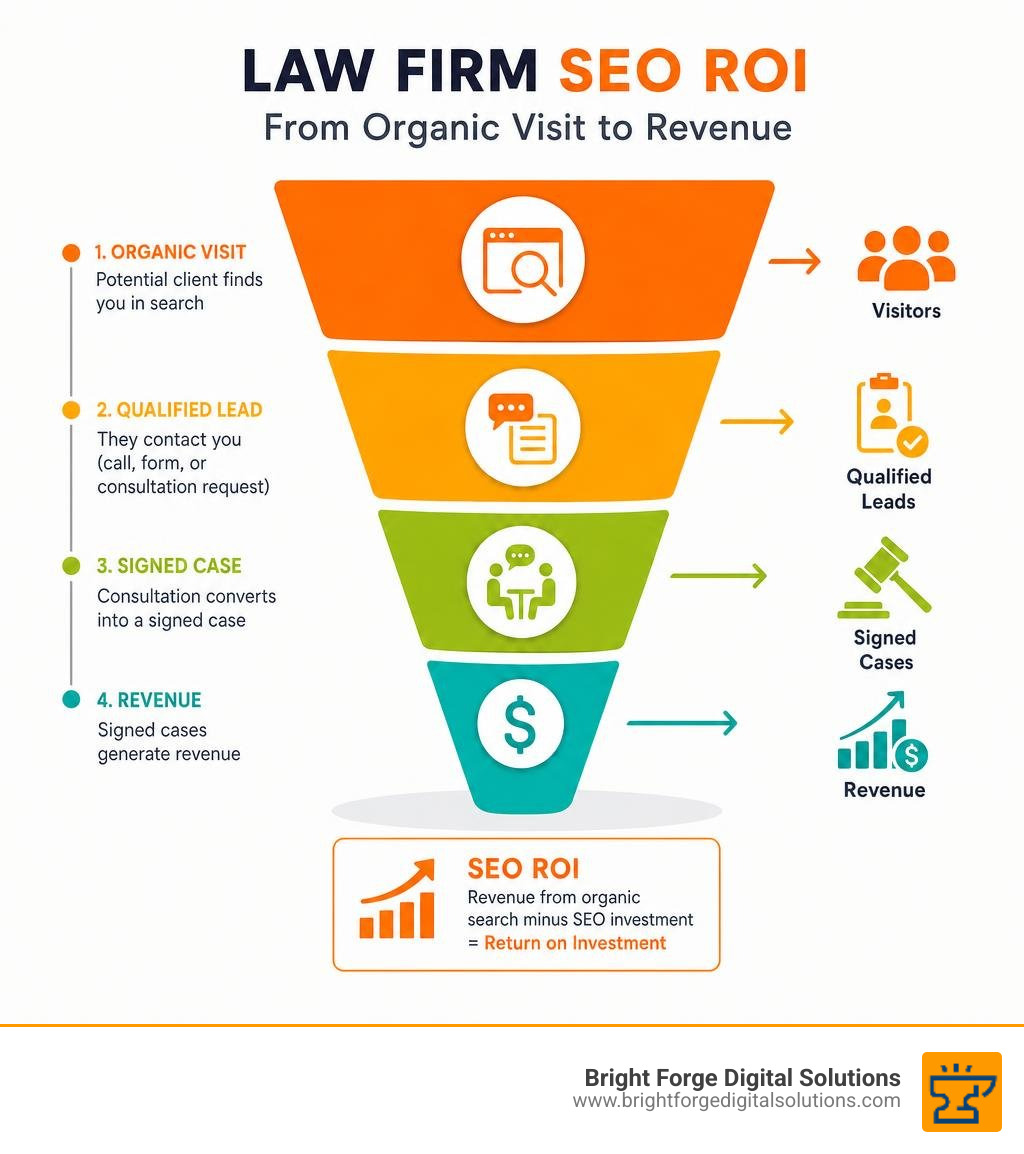
Law firm SEO ROI is the return your firm earns from its organic search investment after you compare SEO costs with the value of qualified leads, signed cases, and revenue. Rankings and traffic can show that visibility is improving, but they do not prove that marketing is bringing in clients.
To measure SEO return on investment, follow the numbers that matter:
- Organic visitors who call, submit a form, or book a consultation
- Qualified leads accepted by your intake team
- Consultations that become signed cases
- The average value or expected revenue of those signed cases
- Your cost per lead, cost per signed case, and net return after SEO costs
For a solo or small firm, this distinction is essential. A page can rank first and still produce weak results if the calls are not qualified, the intake process loses leads, or the cases have too little value to justify the spend. The real question is not, "Did traffic go up?" It is, "Did organic search help the firm acquire profitable clients?"
I am Nick Saucier, longtime Judge Advocate General, legal practitioner, and owner of Bright Forge Digital Solutions, where I work with solo and small firms outside Mississippi. My legal and digital marketing background informs a practical approach to law firm SEO ROI: connect search activity to the client journey and the business results that follow.
Key Metrics to Calculate Law Firm SEO ROI
When we talk with law firm partners about measuring their marketing performance, we often notice a common point of confusion: mistaking activity for progress. Having 10,000 monthly visitors looks fantastic on an agency slide deck, but if zero of those visitors turn into paying clients, your return on investment is exactly zero.
To calculate true law firm SEO ROI, we must categorize search engine data into two distinct buckets: primary revenue drivers and supporting indicators.
While organic traffic growth and bounce rate give us useful context about user experience, they are merely stepping stones. The core engine of your financial return rests on conversion rates, qualified leads, cost per lead (CPL), and average signed case value. To maximize how efficiently traffic converts into phone inquiries, many firms rely on targeted strategy frameworks like 4X Conversions to remove friction from the client intake pathway.
Why Organic Rankings Fail to Prove Law Firm SEO ROI
It is easy to get excited when an agency hands you a report showing your firm is ranking #1 for a high-volume search term. However, search visibility and keyword position are classic "vanity metrics." They tell you that Google sees your site, but they say nothing about whether potential clients trust you enough to pick up the phone.
Ranking first for a broad phrase like "what to do after a car accident" might drive thousands of out-of-state readers or students doing research. While your traffic graphs spike, your bank account remains unchanged. If those searches do not translate into consults in your jurisdiction, high positions fail to yield positive financial returns. SEO success isn't measured in positions; it's measured in profit.
Actionable Lead Generation Metrics That Matter
To bridge the gap between search performance and actual revenue, we focus heavily on actionable metrics. These are numbers that directly influence your firm's bottom line:
- Tracked Phone Calls: Incoming calls generated from organic landing pages or your Google Business Profile.
- Form Submissions & Chat Inquiries: Online intake submissions from prospective clients seeking legal representation.
- Qualified Consultations: The percentage of leads that pass your initial screening criteria and schedule a sit-down or phone review.
- Retained Clients: The ultimate outcome—prospects who sign a retainer agreement.
By centering your measurement system on these tangible indicators, you shift the focus from superficial web traffic to actual pipeline velocity.
Mapping the Client Journey from Click to Retained Case
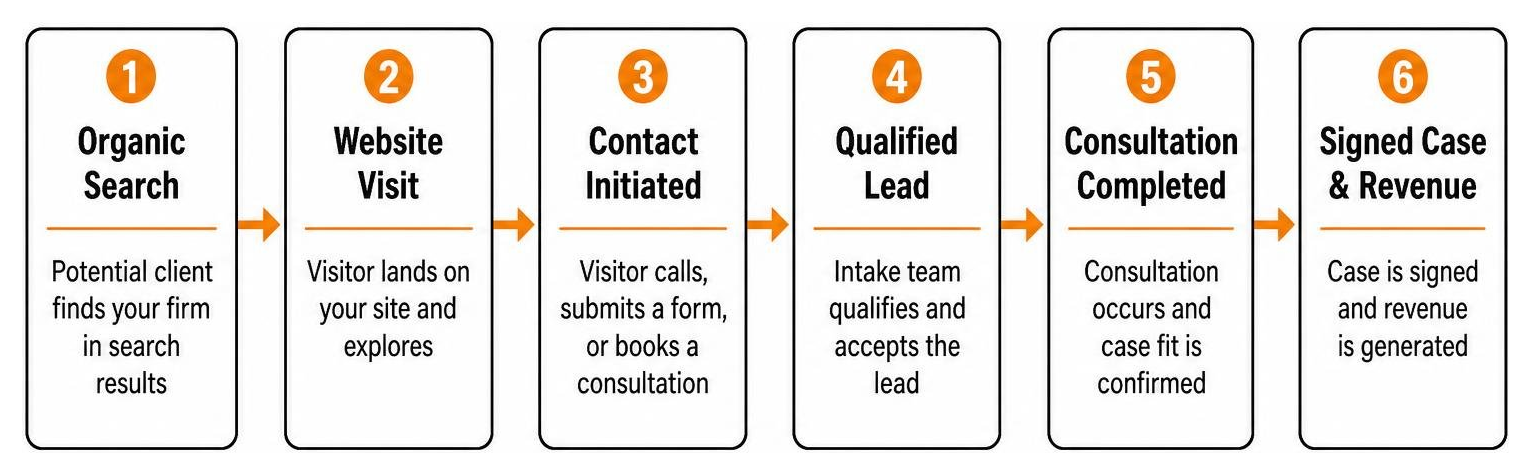
A prospective legal client rarely signs a retainer agreement on their first click. The legal decision-making process involves research, emotional evaluation, and trust-building. To accurately track law firm SEO ROI, you need full visibility across every touchpoint of this lifecycle.
It all starts with high-performing digital assets. Having Winning Websites designed specifically for legal conversion ensures that when qualified organic traffic arrives, visitors immediately find clear calls to action, practice area details, and simple contact forms.
Using Phone Call Tracking to Connect Traffic to Revenue
For most practice areas—especially personal injury, criminal defense, and family law—phone calls represent the vast majority of high-intent leads. If you are not utilizing dynamic call tracking, you are blind to where your best leads originate.

Dynamic call tracking places a lightweight script on your website that displays unique phone numbers based on how the user found you. When a prospect calls from an organic search session, call tracking software attributes the lead to the exact keyword, page, and channel that brought them there. This allows you to pinpoint precisely which search efforts are driving phone calls and revenue.
Integrating Website Analytics with Legal CRM Systems
Call tracking gets you half the answer; connecting that call to your legal Case Management or Customer Relationship Management (CRM) platform completes the puzzle.
By integrating web analytics platforms like Google Analytics with tools such as Lawmatics, MyCase, or Clio, you create an unbroken chain of data:
- Lead Creation: A website call automatically generates a lead record in your CRM labeled with the organic source.
- Consultation Status: Your intake team marks whether the lead met your firm's criteria.
- Signed Case: When the contract is executed, the CRM logs the retainer agreement.
- Settlement/Fee Value: Once the case concludes, the actual revenue earned is mapped directly back to the original SEO channel.
This end-to-end alignment eliminates guessing games and lets you evaluate marketing based on signed client value.
Measuring Financial Returns and Acquisition Costs
Understanding client acquisition economics is critical for budgeting decisions. Evaluating your marketing spend requires comparing what you spend against what you actually gain in fees.
Here is how vanity metrics stack up against actionable financial metrics when assessing organic search performance:
| Metric Category | Vanity Metric (Low Actionability) | Actionable Financial Metric (High ROI Impact) |
|---|---|---|
| Search Presence | Keyword Rankings (#1-#3 positions) | Local Pack Impressions & Direction Requests |
| Traffic Quality | Total Pageviews / Organic Sessions | Qualified Inbound Phone Calls & Intake Forms |
| User Engagement | Bounce Rate / Average Time on Page | Conversion Rate to Completed Consultation |
| Acquisition Cost | Cost Per Click (CPC - Paid Search benchmark) | Cost Per Signed Case (CPA / Cost Per Acquisition) |
| Financial Value | Total Impressions | Net ROI % & Signed Case Revenue Value |
To build an accurate framework for organic growth, review our detailed guide on Local SEO For Law Firms: The Playbook To Get Found, Get Calls, And Get Clients.
Standard Formulas for Measuring Law Firm SEO ROI
Calculating your return does not require a degree in statistics. You can evaluate your campaign's health using three basic formulas.
1. Cost Per Lead (CPL):$$\text{CPL} = \frac{\text{Total SEO Investment}}{\text{Total Organic Leads Generated}}$$
Example: If you invest \$3,000 per month in SEO and receive 30 phone calls and form submissions, your CPL is \$100.
2. Cost Per Acquisition (CPA / Cost Per Signed Case):$$\text{CPA} = \frac{\text{Total SEO Investment}}{\text{Total Signed Cases}}$$
Example: If those 30 leads yield 5 signed cases in a month, your CPA is \$600 per signed case (\$3,000 / 5).
3. Net SEO ROI Percentage:$$\text{SEO ROI} = \left( \frac{\text{Total Gross Revenue from SEO Cases} - \text{Total SEO Investment}}{\text{Total SEO Investment}} \right) \times 100$$
Example: If those 5 signed cases generate \$24,000 in legal fees, and your monthly SEO expense was \$3,000: $$\text{SEO ROI} = \left( \frac{\$24,000 - \$3,000}{\$3,000} \right) \times 100 = 700\%$$
A 700% return means for every dollar you spent on SEO, your firm generated \$7.00 in revenue after covering campaign expenses.
The Role of Average Signed Case Value in Evaluation
When calculating law firm SEO ROI, practice area context matters enormously. A criminal defense firm charging a flat \$3,500 fee for a misdemeanor needs higher volume to achieve strong numbers compared to a personal injury firm where a single motor vehicle accident settlement yields \$50,000 in contingency fees.
Understanding your firm's average signed case value allows you to determine how many cases you need each month just to break even on marketing:
$$\text{Break-Even Case Volume} = \frac{\text{Monthly SEO Spend}}{\text{Average Attorney Fee Per Case}}$$
If your average fee for an estate planning package is \$2,000, and your monthly SEO spend is \$4,000, you need exactly 2 signed clients per month from organic search to hit break-even. Everything beyond those two clients is pure profit expansion.
Strategies to Lower Client Acquisition Costs
Maximizing your law firm SEO ROI isn't just about driving up revenue; it is also about systematically driving down your cost per signed case.

When client acquisition costs fall, profit margins widen. Here are four practical lever points to lower your overall CPA:
- Optimize Your Google Business Profile: Local map listings capture high-intent users who need immediate legal counsel.
- Streamline Phone Intake: Train your reception team to answer inquiries promptly and pre-qualify calls immediately.
- Capture Search Engine Real Estate: Dominate direct auto-fill suggestions before competitors appear by leveraging strategies like Search Box Dominance.
- Maximize Local Social Proof: Generate fresh, high-rated reviews on a recurring schedule with automated systems such as Review Generation & Reputation Management.
Firms seeking a transparent, performance-focused growth model often explore options like Pay Per Result SEO, where marketing investments line up directly with verifiable first-page keyword performance.
Eliminating Common Measurement Mistakes
Even well-meaning law firm owners fall into tracking traps that distort their true marketing picture.
- Short-Term Bias: SEO builds momentum over time. Expecting a massive return in month two leads to pulling the plug right before compound gains take hold.
- Ignoring Direct and Organic Search Synergy: Prospects often discover you via organic search on desktop, but call later by typing your brand directly into their mobile device. Without proper multi-touch modeling, you will under-attribute search marketing.
- Unmapped Intake Systems: If your front-desk intake coordinator records lead sources as "found us online" without asking whether it was Google organic, an ad, or a map listing, your attribution data breaks down.
- Marketing Silos: Evaluating SEO in isolation without factoring in complement channels like Google Advertising or Local Service Ads creates an incomplete picture of your total web presence.
Smarter Budgeting Decisions Based on ROI Data
Data removes emotion from marketing budgets. When you track actual case revenue back to search metrics, you can confidently scale investments in campaigns that bring in profits while reallocating funds away from channels that underperform.
For instance, if your intake data reveals that your organic practice area pages for "family law mediation" yield a \$300 CPA while general "divorce attorney" searches yield an \$1,800 CPA, you can pivot content development to capitalize on high-margin mediation keywords.
Additionally, ensuring your digital presence is updated for modern features like Business Listings & Voice Search helps protect search market share across mobile devices, smart assistants, and automated voice queries.
Frequently Asked Questions About Legal Digital Marketing
What is a good return on investment for legal search marketing?
A general benchmark for successful law firm marketing is a 3x to 5x net ROI(300% to 500% return). For high-contingency fields like personal injury or complex commercial litigation, long-term ROI can far exceed 10x once major cases settle. However, early-stage campaigns or firms operating in hyper-competitive metropolitan markets may initially start closer to a 2x return before compounding visibility drives acquisition costs down.
What are the biggest mistakes law firms make when measuring ROI?
The three biggest errors are:
- Relying solely on traffic reports provided by agencies without matching them to phone records or CRM case logs.
- Failing to train intake personnel to properly identify and record how callers discovered the firm.
- Evaluating SEO on a month-to-month basis rather than reviewing rolling quarter-over-quarter trends.
How long does it take to see a positive return from organic search?
Organic SEO is a compounding long-term investment. Most solo and small law firms see initial search traction and lead flow within 3 to 6 months. Achieving a fully mature, positive return on investment usually occurs between 6 to 12 months, as content authority builds, map positions stabilize, and incoming lead volume scales without a proportional increase in ongoing costs.
Conclusion
Calculating true law firm SEO ROI isn't about counting rankings or admiring traffic graphs—it's about measuring the real-world business growth your legal marketing generates. When you connect organic visits to call tracking, stream leads directly into a legal CRM, and evaluate performance using cost-per-signed-case formulas, you gain full clarity over your marketing investments.
At Bright Forge Digital Solutions, we specialize in clear, performance-driven digital strategies tailored specifically for solo practitioners and small law firms outside Mississippi. If you're ready to stop guessing and start tracking real case revenue, Explore performance-driven digital services for law firms or reach out to us today through our Contact Us page to discuss your law firm's growth targets.