How to Choose the Best Lawyer Review Site

The best lawyer review site depends on what you need to know before you contact an attorney. Avvo is useful for broad attorney coverage, client feedback, and fast legal Q&A. Lawyers.com and Martindale-Hubbell combine client reviews with long-standing peer ratings. Super Lawyers and Best Lawyers are stronger for peer recognition and professional reputation.
| If you want to assess... | Start with... |
|---|---|
| Client communication, responsiveness, and value | Avvo or Lawyers.com |
| Legal skill and standing among other attorneys | Martindale-Hubbell, Super Lawyers, or Best Lawyers |
| A lawyer in a specific city and practice area | Avvo, Lawyers.com, or a local search result |
| A complete picture before a consultation | Two or more review sites, plus the state bar license record |
Reviews matter because legal clients use them when deciding whom to trust with high-stakes problems. But no rating tells the full story. A peer award can signal legal ability, while former-client feedback can reveal whether the lawyer returns calls, explains fees, and treats people with respect.
For a solo or small firm, that difference matters just as much as visibility. The review platforms that send the most traffic are not always the ones that give prospective clients the clearest, most trustworthy information.
I am Nick Saucier, an attorney, long-serving Judge Advocate General in the Mississippi Army National Guard, and owner of Bright Forge Digital Solutions, where I work with solo and small law firms on digital visibility. My legal and marketing experience informs this look at the best lawyer review site options and what their ratings really show.
Evaluating Platform Features to Identify the Best Lawyer Review Site
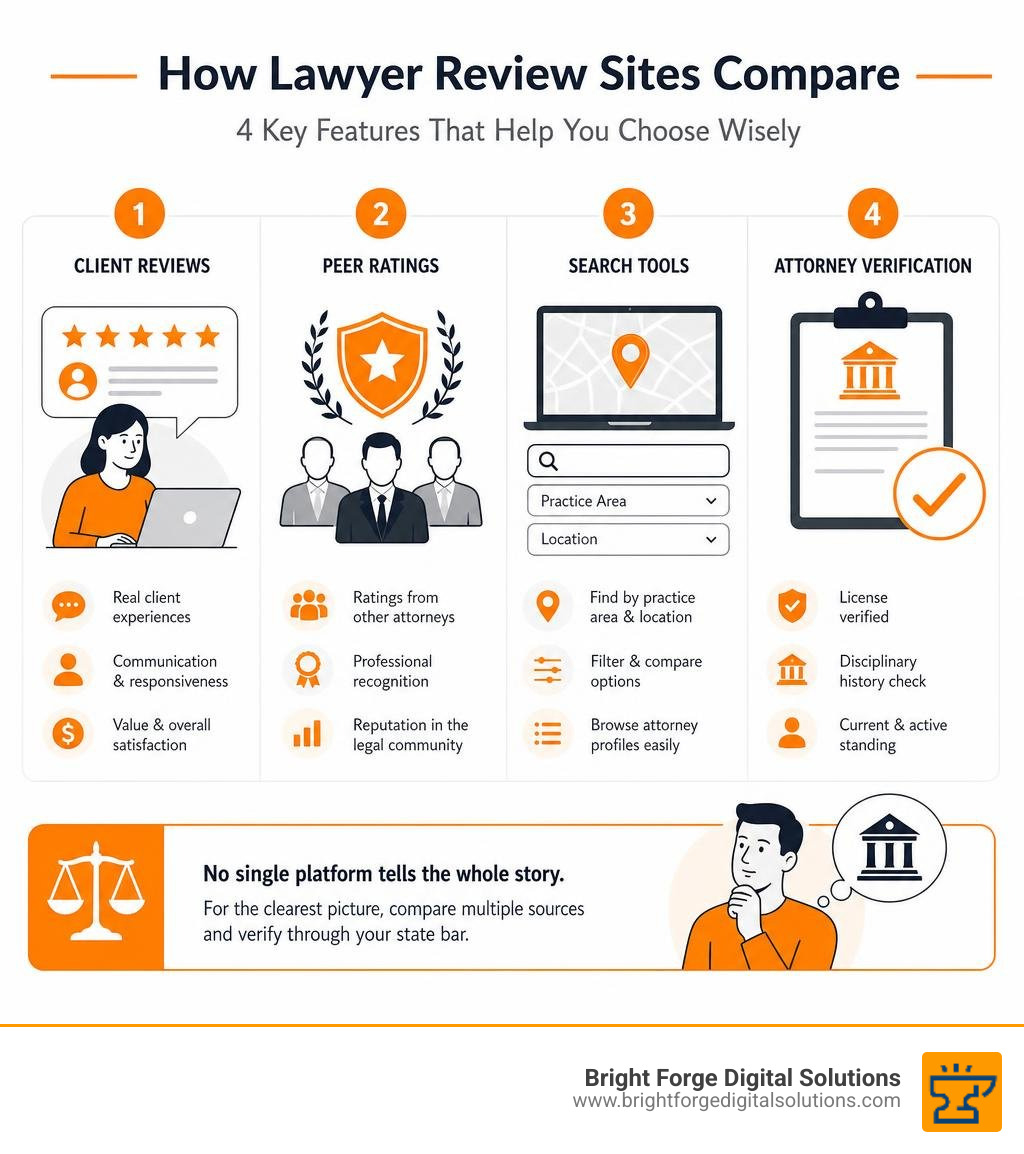
When consumers search for legal representation, finding the best lawyer review site requires understanding how different platforms evaluate attorneys. Over one-third of prospective legal clients rank positive reviews among their top three deciding factors when hiring an attorney. However, not all platforms collect or publish reviews in the same manner.
Evaluating a platform involves looking at four core components:
- Review Verification: Does the platform verify that the reviewer actually hired or consulted with the attorney?
- Practice Area Coverage: Does the site cover specialized legal fields (such as workers' compensation, quiet title actions, or intellectual property) or only general categories?
- Geographic Search Capabilities: Can you accurately search by city, county, or state to find attorneys familiar with local court rules and agencies?
- Directory Database Depth: Does the site index a complete list of licensed practitioners or only attorneys who pay for advertising?
Avvo: The Best Lawyer Review Site for Fast Client Ratings and Q&A
Avvo is widely recognized as a go-to platform for quick consumer research and accessible legal guidance. With over 65 million annual visitors and 8 million monthly users, Avvo maintains an extensive legal database covering roughly 97% of all practicing lawyers in the United States—totaling over 1.1 million attorney profiles.
Avvo evaluates lawyers using a proprietary 1-to-10 numerical scale. This score is generated by an automated algorithm that evaluates background data, years in practice, disciplinary history, professional achievements, and industry endorsements. Because the basic score is calculated programmatically across public records, attorneys cannot pay to alter or boost their score.
Key features of Avvo include:
- Interactive Legal Q&A Forum: Users can post anonymous legal questions and receive answers from verified attorneys, with over 17 million legal questions answered to date.
- Client Feedback: Detailed former-client reviews focusing on soft skills like responsiveness, empathy, and billing clarity.
- Upfront Pricing Transparency: Thousands of listed attorneys outline starting hourly rates (often starting around $149 per hour) or flat consultation fees.
To research practitioner backgrounds or consult community Q&As, visit the main Avvo Lawyer Directory or search localized listings through the Find a Lawyer Directory.
Lawyers.com and Martindale-Hubbell: Combining Client Feedback with Historical Heritage
For consumers seeking a platform backed by decades of legal industry authority, Lawyers.com and Martindale-Hubbell represent the gold standard in dual-perspective attorney evaluations. Martindale-Hubbell has been matching consumers with attorneys for over 150 years, creating a massive network that today reaches 25 million monthly visitors and over 100,000 daily active users.
Lawyers.com includes profiles for approximately 95% of practicing U.S. attorneys across more than 1,000 legal practice areas. What sets this network apart is its seamless combination of two distinct evaluation metrics:
- Peer Review Ratings: Peer evaluations derived from feedback submitted by competing attorneys and judges. Ratings include AV Preeminent (the highest standard of legal excellence), Distinguished, and Notable.
- Client Review Ratings: Numerical 1-to-5 ratings evaluating attorneys across four crucial operational areas: Communication Ability, Responsiveness, Quality of Service, and Value for Money.
Lawyers who maintain high client ratings over a two-year period earn Martindale-Hubbell Client Champion awards (awarded at Platinum, Gold, and Silver levels depending on review volume and average scores). To learn more about how these dual evaluation tiers function, explore the official Consumer Guide to Ratings.
Super Lawyers and Best Lawyers: Dedicated Peer-Reviewed Directories
When legal clients need to evaluate an attorney's professional standing among other legal professionals, peer-reviewed directories offer a rigorous, objective window into peer reputation.
Super Lawyers uses a patented multiphase selection process (U.S. Patent No. 8,412,564) combining independent research, peer nominations, and peer evaluations. Each year, Super Lawyers selects no more than the top 5% of attorneys in each state or region to its formal list.
Best Lawyers operates on a purely peer-reviewed methodology, capturing over 20 million evaluations of attorneys by their peers across 151 practice areas over 40 years. Best Lawyers recognizes only the top 3% of practicing lawyers globally, making it a primary resource for corporate general counsel and individuals seeking elite legal counsel. To search these peer-evaluated rankings, you can access the Best Lawyers Peer Directory.
AttorneyReview and TrustReviewers: Niche Consumer Comparison Portals
Beyond traditional directory giants, niche comparison platforms cater to modern legal consumers looking for streamlined decision-making tools and localized review feeds.
- AttorneyReview: Combines traditional lawyer directory listings with interactive tools, such as a 60-second, 5-question practice area quiz and an AI case evaluator tool. Prospective clients can compare credentials, fee models, and user ratings side by side. Visit the AttorneyReview Directory to utilize these comparison features.
- TrustReviewers: Functions as a targeted directory displaying localized, verified client feedback. For example, state directories index thousands of verified opinions (such as Rhode Island listing 2,991 reviews across 164 attorneys, or New York displaying 2,669 reviews across 196 attorneys). You can browse state-by-state user feedback through the TrustReviewers Attorney Directory.
Peer Reviews vs. Client Reviews: Which Rating System Is More Reliable?
When evaluating a lawyer online, consumers frequently encounter two distinct rating formats: peer reviews and client reviews. Understanding the difference between these evaluation types prevents misinterpreting what a high score actually signifies.
| Evaluation Criteria | Peer Review Ratings (e.g., Best Lawyers, Martindale) | Client Review Ratings (e.g., Avvo, Google) |
|---|---|---|
| Evaluators | Fellow licensed attorneys and state judges | Former clients and legal consumers |
| Primary Focus | Legal knowledge, analytical ability, and ethical standards | Responsiveness, empathy, fee clarity, and customer service |
| Best For Assessing | Complex courtroom capability and legal acumen | Day-to-day communication and client support experience |
| Potential Limitations | May favor established, large-firm attorneys | Can be influenced by case outcomes outside attorney control |
Evaluating Legal Competence Through Peer Recognition
Peer reviews evaluate an attorney’s technical skill, legal knowledge, judgment, and adherence to professional ethics. Because peer ratings come from opposing counsel and judges who have witnessed the attorney work in court, they provide an objective measure of pure legal ability.
For instance, earning an AV Preeminent rating from Martindale-Hubbell or being named to Best Lawyers requires sustained professional achievement over many years. Peer evaluations indicate whether an attorney possesses the legal capability to handle complex litigation, draft airtight legal agreements, or navigate intricate state statutes.
Gauging Client Satisfaction Through Real User Feedback
While peer recognition measures technical ability, client reviews reveal what it is actually like to work with the lawyer on a personal level. A lawyer can be a brilliant legal mind, but if they take three weeks to return phone calls or fail to explain billing invoices, the client experience will be frustrating.
Client reviews—featured heavily on directories and platforms like Google Business Profiles—measure real-world service delivery. Former clients evaluate whether the attorney explained legal concepts clearly, provided realistic expectations, maintained billing transparency, and treated them with respect. To learn how law firms organize public client feedback on search engines, see our guide on Google Lawyer Reviews.
Paid Influence, Biases, and How to Interpret Review Ratings
A common question among legal consumers is whether attorneys can pay to boost their numeric ratings, remove bad feedback, or buy top positions on review portals.

Can Lawyers Pay to Change Their Ratings or Suppress Reviews?
On reputable review portals, lawyers cannot pay to directly alter or purchase higher numerical ratings. Scores on Avvo, peer tiers on Martindale-Hubbell, and recognitions on Best Lawyers are strictly controlled by independent algorithms or peer evaluation surveys.
However, platforms do offer paid marketing placements. Attorneys can buy sponsored listings that place their profiles at the top of search results pages for specific practice areas or geographical regions. Transparency policies require these listings to be clearly marked with labels such as "Sponsored," "Ad," or "Promoted."
Regarding negative client feedback, platforms maintain strict suppression policies:
- All-or-Nothing Display Rules: On platforms like Martindale-Hubbell and Lawyers.com, an attorney cannot selectively delete individual negative reviews. They can choose to suppress all client reviews, but doing so places an explicit public disclosure on their profile stating that the lawyer has elected not to display reviews.
- Disciplinary Triggers: If an attorney receives an official state bar suspension or disciplinary action, platforms automatically remove verified badges, Client Champion recognitions, and peer award displays.
Navigating Missing Reviews, Unreviewed Attorneys, and Mixed Feedback
A lack of online reviews or a mixed overall score does not automatically indicate an unqualified lawyer. Interpreting review profiles accurately requires contextual understanding:
- Unreviewed Attorneys: Solo practitioners with niche corporate practices, veteran trial attorneys who rely exclusively on word-of-mouth referrals, or newly admitted lawyers may have few or no online client reviews despite high competence.
- Contextualizing Mixed Ratings: In legal disputes—especially emotional fields like divorce, child custody, or criminal defense—outcomes are rarely entirely favorable to both sides. A client who receives an unfavorable court ruling may leave a bitter one-star review even if the attorney performed admirably under difficult facts.
- Identifying Service Trends: Look past single emotional outbursts and analyze long-term operational patterns. Multiple reviews mentioning unreturned calls, unexpected fee additions, or missed deadlines represent legitimate operational red flags.
How to Combine Review Platforms for a Complete Attorney Evaluation
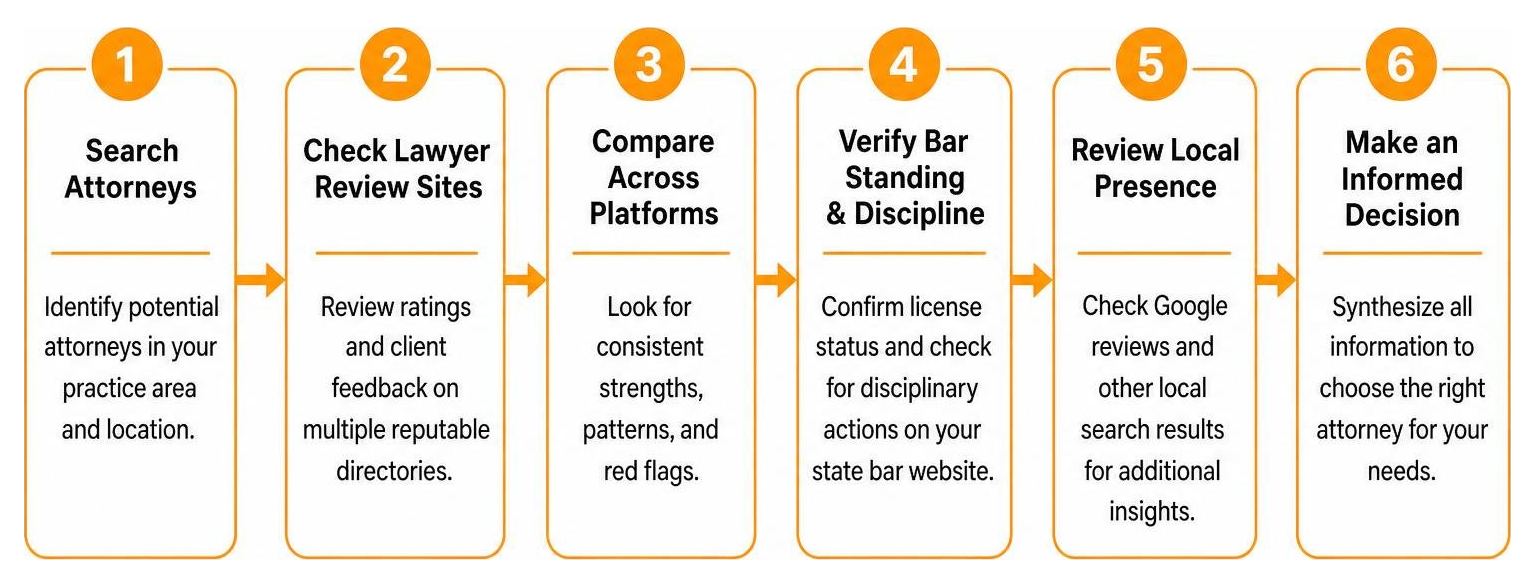
To make an informed decision when retaining legal counsel, we recommend using a multi-step evaluation workflow rather than relying on a single directory score.
How to Combine Multiple Directories with the Best Lawyer Review Site
By cross-referencing information across multiple review portals, state licensing databases, and local search results, you create a balanced profile of any attorney you consider hiring.
Here is an actionable step-by-step evaluation workflow:
- Check Technical Competence: Search Best Lawyers, Super Lawyers, or Martindale-Hubbell to verify peer standing, legal ethical records, and industry recognitions.
- Review Client Service Standards: Visit Avvo, Lawyers.com, or Google to read recent client reviews focusing on communication frequency, fee structures, and staff helpfulness.
- Verify Official License and Discipline Records: Visit your official State Bar Association website (e.g., The Florida Bar, State Bar of California) to confirm active licensing status and check for public disciplinary actions.
- Evaluate Local Digital Presence: Review the firm's website and localized profiles to confirm they regularly represent clients in your immediate city or county courts. For solo practitioners and small law firms seeking to improve their own digital visibility across localized searches, see our resource on Local SEO for Law Firms or browse our specialized Services.
When contacting prospective attorneys for an initial consultation, bring a prepared checklist of questions:
- What percentage of your daily practice focuses directly on my legal issue?
- Will you handle my case personally, or will associate attorneys and paralegals perform the majority of the work?
- How are fees calculated (contingency percentage, flat fee, or hourly rate), and what out-of-pocket court costs am I responsible for?
- How quickly does your office typically respond to client email inquiries or phone calls?
Frequently Asked Questions About Lawyer Review Sites
What is the most accurate directory for checking an attorney's reputation?
There is no single site that provides a complete assessment on its own. The most complete approach combines peer-reviewed directories (such as Best Lawyers or Martindale-Hubbell) for legal technical skill, client review portals (such as Avvo or Lawyers.com) for client service evaluation, and your official State Bar Association directory for license status and disciplinary verification.
What does it mean if a lawyer has no online reviews?
A lack of reviews usually indicates that the attorney practices in a corporate, institutional, or referral-heavy field where public consumer reviews are rarely requested. It can also mean the lawyer recently launched an independent solo practice or simply has not set up digital review generation tools.
Can an attorney delete a bad review from a review site?
Attorneys cannot directly delete legitimate negative reviews simply because they disagree with the criticism. Reviews can only be removed if they violate a platform's Terms of Service (such as containing profanity, false statements from non-clients, or hate speech) or if the attorney elects to suppress all reviews across the platform, which triggers a standard public disclosure.
Conclusion
Finding the best lawyer review site comes down to knowing what legal qualities matter most for your specific situation. Peer-reviewed directories like Best Lawyers and Super Lawyers offer insight into professional standing and technical skill. Client-focused platforms like Avvo and Lawyers.com provide honest feedback regarding communication, value, and client service. Using multiple review portals alongside official state bar license checks ensures you choose legal representation with confidence.
For solo practitioners and small law firms, maintaining an authentic, verified digital reputation across these major platforms is critical to building prospective client trust. To discover how our performance-based digital agency helps law firms generate authentic client reviews and gain dominant local search rankings, learn more about our specialized strategies for Review Generation Reputation.