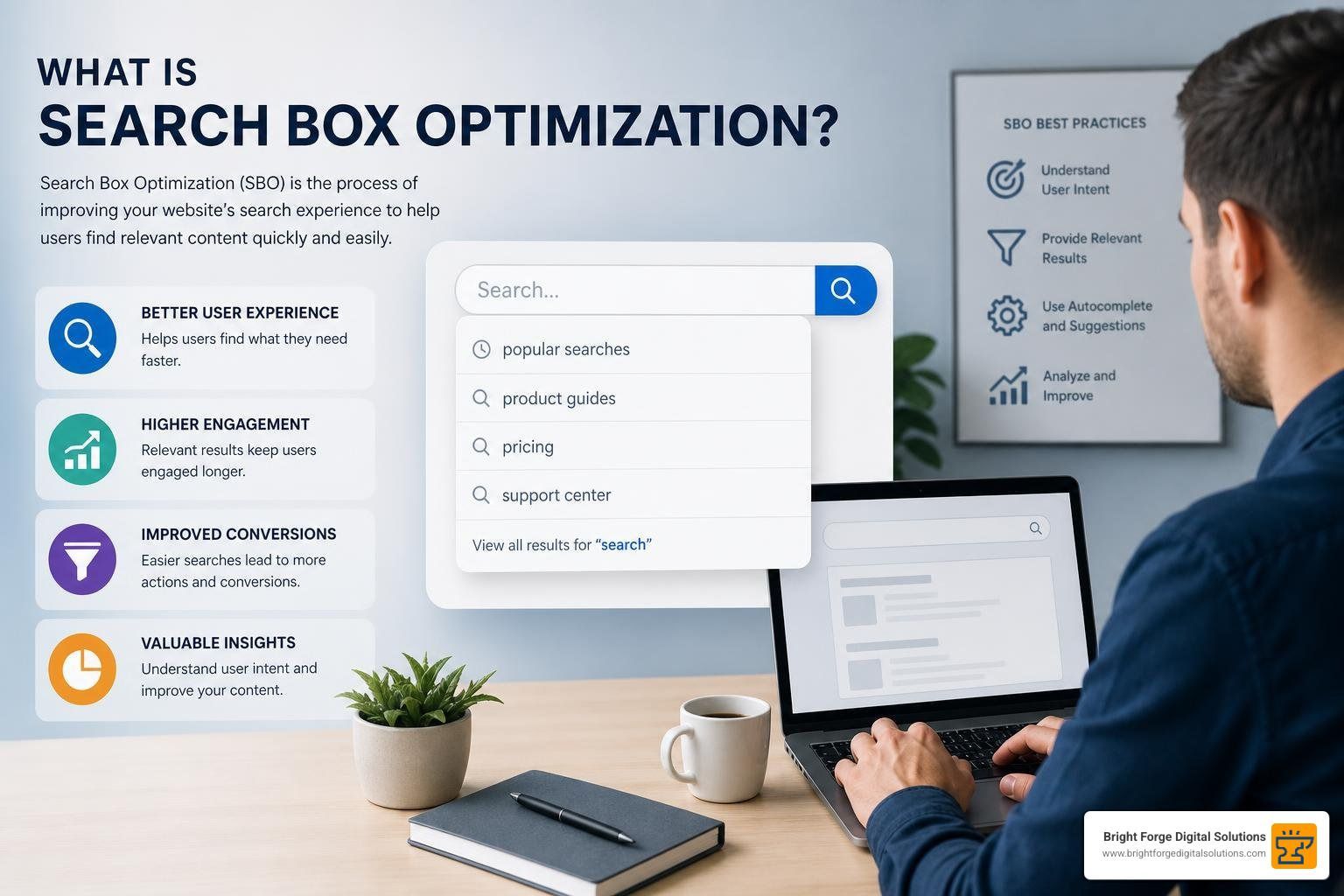
Why Google Local Service Ads Matter for Law Firms

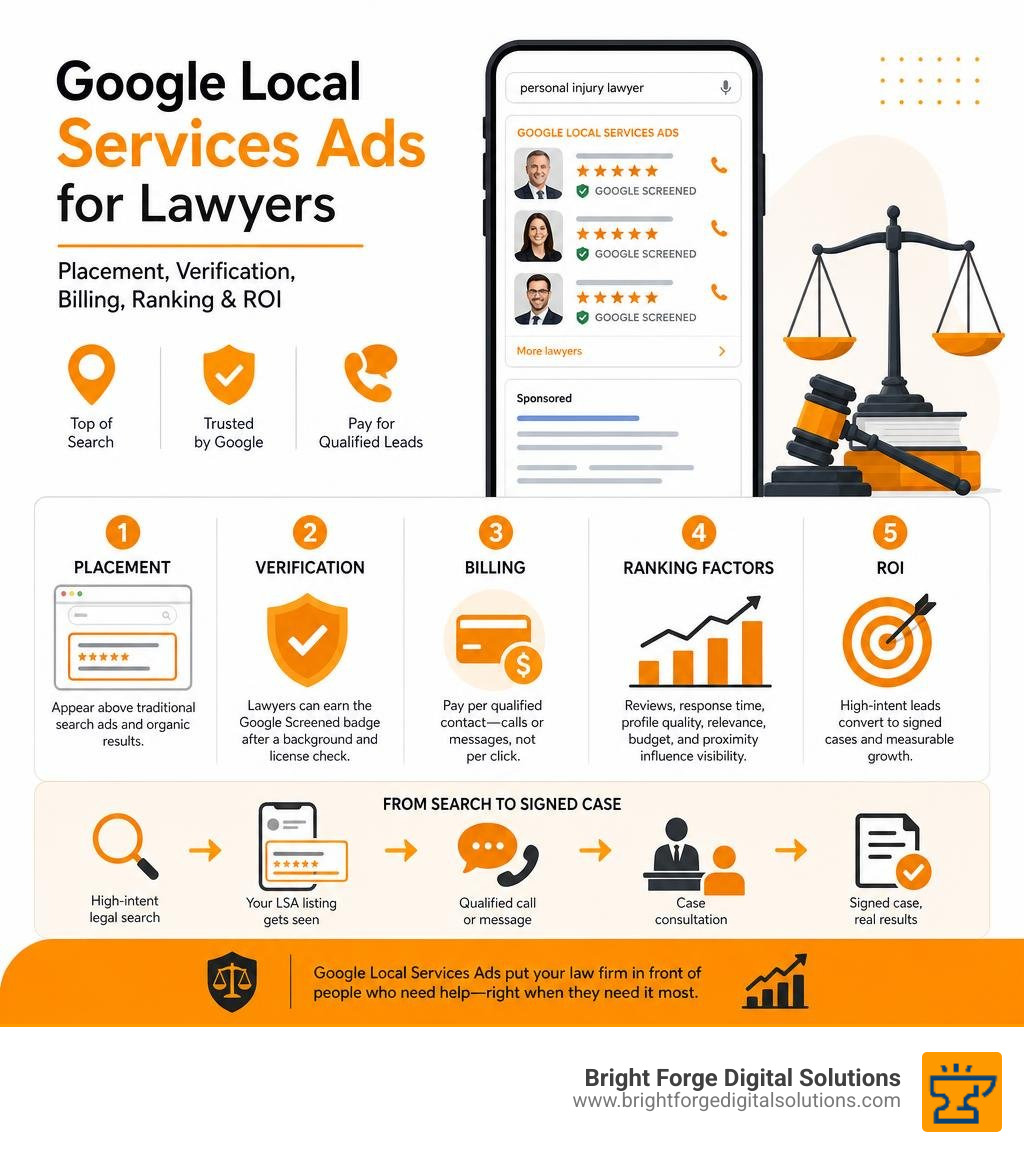
Google local service ads for lawyers are top-of-results ads that help local firms attract people looking for immediate legal help. Unlike standard Google Ads, Local Services Ads charge per qualified contact rather than every click, and eligible firms can display the Google Screened badge after verification.
| What to know | Quick answer |
|---|---|
| Where LSAs appear | Usually above traditional search ads and organic results |
| How firms pay | Per lead, such as a phone call or message, not per click |
| Trust signal | Lawyers can qualify for the Google Screened badge |
| What drives visibility | Reviews, fast responses, profile quality, relevance, budget, and proximity |
| Best use | Capture high-intent local prospects while supporting SEO and standard Google Ads |
For a solo or small firm, that placement can be hard to ignore. LSAs earn an estimated 13.8% of search-result clicks when they appear, and strong star ratings often matter more to prospective clients than the exact position of the ad.
This guide explains how eligibility, Google Screened verification, budgets, lead disputes, reviews, and intake speed affect results. It also shows where LSAs fit alongside local SEO and standard Google Ads, so you can judge performance by signed cases and acquisition cost , not just calls.
I am Nick Saucier, longtime Judge Advocate General, and practicing attorney who understands the professional and ethical realities behind google local service ads for lawyers. Through Bright Forge Digital Solutions, I help solo and small law firms turn local search visibility into a more measurable client-growth system.
Understanding Google Local Service Ads for Lawyers vs. Standard PPC
When potential clients face an urgent legal emergency—whether a serious motor vehicle collision, an unexpected criminal charge, or an immediate divorce filing—their search usually starts on a mobile phone. Understanding how google local service ads for lawyers fit into the search engine results page (SERP) is essential for maximizing visibility and controlling marketing expenditure.
Local Services Ads (LSAs) occupy the absolute highest real estate on Google, sitting right above pay-per-click (PPC) text ads, local map packs, and organic listings. This prime placement delivers immediate visual authority, presenting searchers with your firm's headshot, business name, Google star rating, office hours, and the official Google Screened badge.
| Feature | Google Local Services Ads (LSA) | Standard Google Ads (PPC) |
|---|---|---|
| Billing Model | Pay-Per-Lead (PPL) — Phone calls or direct messages | Pay-Per-Click (PPC) — Every ad click regardless of contact |
| SERP Placement | Very top of page (above traditional ads) | Below LSAs, above or below organic map results |
| Trust Credential | Google Screened badge (Blue checkmark) | Ad extension callouts (No official Google endorsement badge) |
| Targeting Basis | Geographic radius, practice categories, lead status | Specific keywords, match types, positive/negative keywords |
| Landing Page | Google-hosted standardized firm profile | Custom law firm website landing page |
| Primary Ranking Signal | Reviews, proximity, responsiveness, active budget | Quality Score, bid amount, landing page UX, click-through rate |
How Google Local Service Ads for Lawyers Differ from Traditional Ads
The fundamental distinction between LSAs and traditional search advertising lies in user intent and ad mechanics. Standard Google Ads require extensive keyword research, bidding strategies on competitive terms like "personal injury attorney near me," and dedicated landing page optimization. Searchers click an ad, land on your website, and decide whether to call or fill out a form. You pay for that click whether the user converts, leaves immediately, or turns out to be a vendor selling legal software.
LSAs streamline this pathway dramatically. When prospective clients tap an LSA, they do not visit your website; instead, they see a concise, Google-hosted profile showcasing your practice areas, client reviews, attorney headshots, and direct action buttons ("Call" or "Message").
Because LSAs sit at the absolute top of search results, they significantly reshape how users interact with search pages. Research shows that when LSAs appear on a search results page, total paid search click share expands from 14% to approximately 25%, while organic click share slightly contracts from 50% to around 44%. For law firms looking to capture motivated, high-intent traffic, integrating dedicated Local Service Ads solutions creates an immediate pipeline to prospects ready to hire legal representation right now.
Pay-Per-Lead Billing Model and Budget Management
The financial model of LSAs is built around direct client engagement. Rather than paying $50 to $300+ per click on high-competition legal keywords in traditional PPC, google local service ads for lawyers operate on a pay-per-lead structure. You are billed only when a prospective client connects directly through your ad by:
- Initiating a phone call that lasts longer than a baseline duration (typically over 30 seconds).
- Sending a direct message inquiry through the Google interface.
- Leaving a voicemail through the LSA tracking number.
You set a weekly budget based on the volume of leads your law firm can comfortably handle. If your firm sets a $1,000 weekly budget and average cost-per-lead in your practice area is $100, Google aims to deliver approximately 10 qualified leads per week. If Google delivers fewer leads in a slow week, you are charged only for the leads received. If volume surges, Google may spend up to your monthly maximum limit (weekly budget multiplied by ~4.33), but will never exceed it over a monthly billing cycle.
To dive deeper into standard ad mechanics and custom keyword targeting, explore our detailed breakdown of Google Advertising.
Getting Google Screened: Verification, Eligibility, and Setup Step-by-Step

Trust is the single most important currency in legal marketing. The Google Screened badge—represented by a distinctive blue checkmark next to your law firm’s name—instantly tells searchers that your attorneys are licensed, vetted, and in good standing.
Unlike home service providers who earn a "Google Guaranteed" badge (which includes consumer financial reimbursement guarantees up to $2,000), professional service providers like law firms earn the Google Screened badge. This distinction highlights that Google has verified your firm's professional credentials, bar licensing, and business registration.
Verification Requirements and Legal Practice Area Eligibility
To qualify for the Google Screened mark, law firms must complete a thorough background verification conducted through Google's official third-party screening partners (such as Pinkerton). The screening criteria include:
- State Bar License Verification: Every attorney listed on the profile who provides direct legal advice must hold an active, unencumbered license in good standing with the state bar association.
- Business Entity Verification: Proof of active business registration with state regulatory bodies.
- Malpractice Insurance Coverage: Submitting proof of current professional liability insurance policies meeting state minimum requirements.
- Background Checks: Background checks on individual attorneys and business owners to verify identity and criminal history checks.
Google continues to expand LSA practice area eligibility across the legal sector. Today, eligible practice areas include:
- Personal Injury Lawyers
- Criminal Defense Lawyers
- Family & Divorce Attorneys
- Bankruptcy Lawyers
- Estate Planning & Probate Attorneys
- Immigration Lawyers
- DUI / DWI Specialists
- Real Estate Lawyers
- Business & Contract Litigation Attorneys
- Intellectual Property & Malpractice Attorneys
- Traffic Ticket & Labor Lawyers
Launching Google Local Service Ads for Lawyers in 5 Simple Steps
Setting up google local service ads for lawyers requires precision to ensure approval without unnecessary delays. On average, the verification process takes between 2 to 4 weeks.

Here is the step-by-step process to get your firm live on LSAs:
- Check Eligibility & Create Account: Visit the Google Local Services portal, confirm your primary business zip code and legal practice areas, and link your existing Google Business Profile.
- Define Service Areas & Practice Sub-Categories: Specify the exact geographical zones (counties, cities, or zip codes) you serve. Select specific sub-specialties within your practice areas (e.g., under Personal Injury, check Car Accidents, Slip and Fall, and Wrongful Death).
- Set Weekly Budget & Bidding Strategy: Choose your target weekly expenditure and select your bid mode (Maximized Bids for volume or Max Bid Per Lead to set cap limits).
- Upload Documentation & Submit Screening: Provide active state bar numbers, malpractice insurance certificates, business registration documents, and complete background check forms.
- Set Call Schedule & Launch Campaign: Define the exact hours your office staff or intake service answers phone calls, turn the campaign live, and monitor initial incoming calls.
For additional strategies on setting up attorney campaigns, check out Clio’s guide on Google Local Services Ads for Lawyers.
Critical Ranking Factors and Profile Optimization Strategies
Unlike standard organic search, where technical site structure and backlinks dominate, LSA ad positioning relies on a specialized set of local proximity, reputation, and operational responsiveness metrics.

Google determines LSA positioning using these primary ranking factors:
- Review Ratings & Volume: Total review count and overall star rating (a minimum 4.5+ average rating is ideal).
- Proximity to Searcher: Geographic distance between the prospective client's search location and your physical office address.
- Intake Responsiveness: How quickly and reliably your firm answers incoming LSA phone calls and responds to direct messaging requests.
- Profile Completeness & Hours: Having complete practice descriptions, headshots, and clear, active operating hours.
- Bidding & Budget Availability: Competitive bid settings and consistent active budget availability throughout the week.
Maximizing Review Quantity, Ratings, and Firm Responsiveness
Star ratings are the single most compelling visual factor motivating searchers to click an LSA listing. In fact, a lower-placed ad featuring a 4.9-star rating and 120 reviews frequently pulls more calls than a top-ranked listing with a 4.1-star rating and 8 reviews.
Because 76% of legal consumers who are asked to leave a review end up leaving one, building a systematic review engine is critical. Here is how leading firms optimize their reviews and responsiveness signals:
- Connect Google Business Profile Reviews: Ensure your LSA account is linked to your Google Business Profile so all existing online reviews feed directly into your LSA listing.
- Automate Post-Case Requests: Implement text message and email outreach immediately upon successful resolution of a case matter.
- Enforce Strict Phone Intake Rules: Unanswered calls directly harm your LSA quality score and drop your search positioning. Ensure every call is answered within 3 rings by trained legal intake staff or a dedicated 24/7 legal answering service.
- Maintain Ethical Ethics Compliance: When replying to reviews publicly on Google, avoid revealing case details, client names, or legal outcomes to strictly uphold attorney-client confidentiality rules mandated by state bars.
Handling Invalid Lead Disputes and Profile Completeness
One major advantage of google local service ads for lawyers is the ability to dispute invalid charges. While Google automatically filters clear spam, law firms can request credit refunds for leads that do not meet legitimate qualification criteria directly within the LSA dashboard within a 30-day window.
Valid reasons to dispute an LSA lead charge include:
- Wrong Practice Area: A caller seeking patent litigation when your profile clearly targets family law.
- Out-of-Jurisdiction / Geography: Caller looking for representation in a state or region outside your designated target service area.
- Spam, Robocalls, or Solicitations: Automated sales calls, recruiters, or wrong numbers.
- Duplicate Contacts: A prospect who called multiple times within a short duration.
Regularly auditing your call logs and filing dispute requests keeps your cost-per-lead low and protects your monthly budget. For a broader perspective on agency management, explore Inoriseo's analysis of Local Services Ads for Lawyers.
Combining LSAs with Search Box Optimization and Local SEO for Maximum Legal Growth
While google local service ads for lawyers offer immediate visibility, relying solely on a single paid ad channel leaves your practice vulnerable to algorithm changes, budget caps, and rising lead costs. The most resilient law firms combine LSAs into a broader local search engine dominance strategy.
SERP Dominance and Multi-Channel Lead Strategy
True search engine dominance occurs when your law firm controls every major section of the Google search results page simultaneously:
- Top Real Estate: Google Local Services Ads with Google Screened badge.
- Upper Middle Section: Standard Google Search Ads targeting specific long-tail keywords.
- Map Real Estate: Local Google Business Profile appearing in the Local Map Pack (3-Pack).
- Organic Search Results: High-ranking website content powered by comprehensive organic SEO and Search Box Optimization.
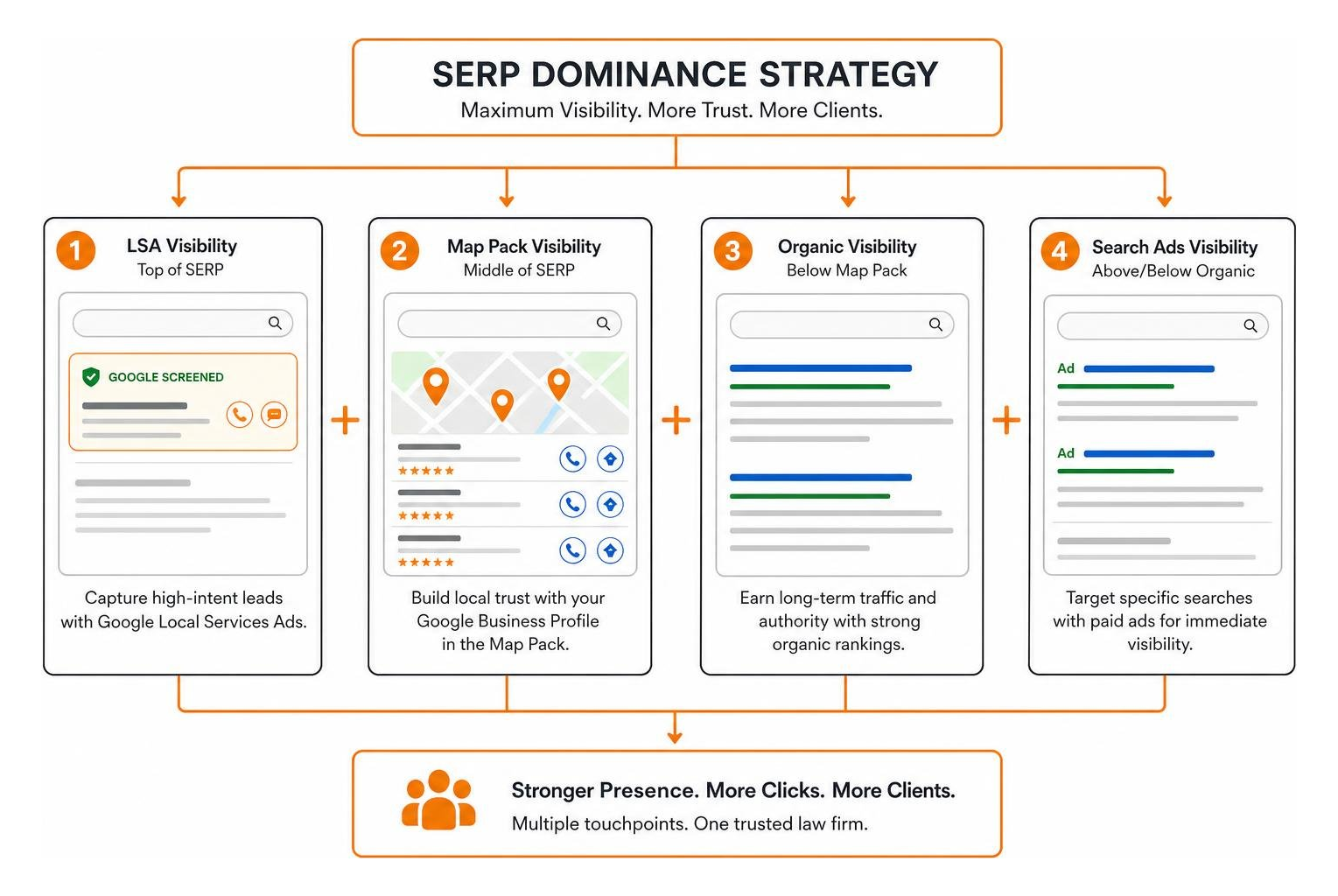
When prospects see your law firm featured at the top of LSAs, highlighted in the map pack, and ranking organically on the exact same page, trust increases exponentially. This multi-touch presence reinforces firm authority and maximizes click-through conversion across all marketing channels.
To build an organic foundation that complements your paid campaigns, review our guide on Local SEO for Law Firms.
Tracking Campaign ROI and Cost-Per-Signed-Case
Measuring digital marketing success by "lead volume" alone can be misleading. A law firm receiving 50 phone calls a month at $100 per lead is losing money if poor intake converts only one client. Real marketing ROI is measured by Cost-Per-Signed-Case (CPSC).
$$\text{Cost Per Signed Case} = \frac{\text{Total LSA Ad Spend}}{\text{Total Signed Clients Acquired}}$$
For instance, consider a real-world scenario from the legal sector: solo practitioners and growing firms often use digital intake integrations and structured ad campaigns to build thriving practices. One published case study demonstrated how an attorney leveraged legal client management tools alongside Google Local Services Ads to take a firm from zero revenue to $250,000 in income within two years.
To evaluate how performance-based ranking models eliminate financial risk while building organic authority, discover how Pay Per Result SEO pairs with paid LSA campaigns.
Common LSA Pitfalls Law Firms Must Avoid
Even high-performing legal practices can waste ad spend on LSAs by making simple setup and management mistakes. Avoid these frequent missteps to keep your campaigns profitable:
- Selecting Overly Broad Practice Areas: Checking every practice category during account setup dilutes relevance signals. Focus strictly on your core revenue-generating practice areas.
- Ignoring Missed Calls and Slow Response Times: Google's ranking algorithm penalizes accounts that let calls go to voicemail or delay responding to message leads.
- Failing to Dispute Non-Qualifying Leads: Letting out-of-jurisdiction, wrong-category, or spam calls go un-disputed wastes marketing budget.
- Setting Profile Hours Beyond Real Intake Capacity: Listing your profile as "Open 24 Hours" when no one is available to answer late-night calls hurts response metrics and wastes ad spend.
- Neglecting Consistent Review Collection: Stopping review generation after getting 5 or 10 reviews allows local competitors with active review engines to quickly pass you in ranking.
Frequently Asked Questions About Local Service Ads for Lawyers
How do law firms dispute invalid leads in Local Services Ads?
Law firms can dispute non-qualifying or fake leads directly inside the Google Local Services Ads management dashboard within 30 days of the call. Valid grounds for credit refunds include spam robocalls, wrong geographic locations, wrong practice areas, or wrong numbers. Once submitted, Google reviews the recorded audio log or call data and issues credit back to your active ad balance for validated claims.
What is the difference between Google Screened and Google Guaranteed?
The Google Screened badge (blue checkmark) is assigned to professional service firms like lawyers, accountants, and financial advisors upon verifying state bar licenses, insurance coverage, and business records. The Google Guaranteed badge (green checkmark) is reserved for home service categories (e.g., plumbers, electricians) and includes a money-back consumer protection policy backed by Google up to $2,000. Google Screened does not include financial reimbursement guarantees.
How long does the Google Screened background check process take?
The verification process typically takes between 2 to 4 weeks. The exact timeline depends on how quickly your firm submits state bar license numbers, business entity documentation, proof of malpractice insurance, and completes background check applications through Google's third-party background vendor.
Conclusion
Google local service ads for lawyers represent one of the most effective, direct, and controllable marketing tools available to modern law firms. By positioning your practice at the absolute top of search results with the Google Screened checkmark, you earn immediate client trust right at the moment legal help is needed most.
Success requires more than simply turning on an ad campaign. By focusing on rapid phone intake response, systematic review management, routine lead disputing, and integrating LSAs with local SEO, your practice can lower client acquisition costs and establish dominant market presence.
At Bright Forge Digital Solutions, we specialize in helping solo practitioners and growing law firms build high-converting search strategies with transparent performance models. Ready to capture higher-quality legal leads and grow your practice? Explore our tailored Local Service Ads solutions today to claim top search placement in your local legal market.